
News
100 years since Lady Haig’s Poppy Factory first blossomed
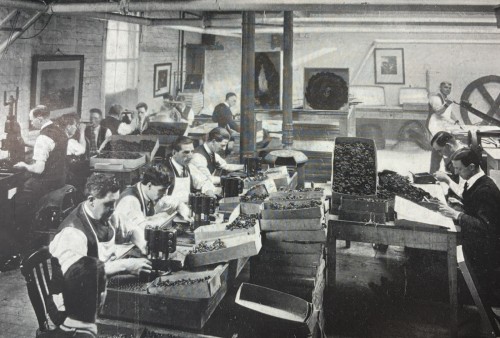
On 8 March, Lady Haig’s Poppy Factory celebrates a remarkable 100 years of production in Scotland – fittingly coinciding with International Women’s Day.
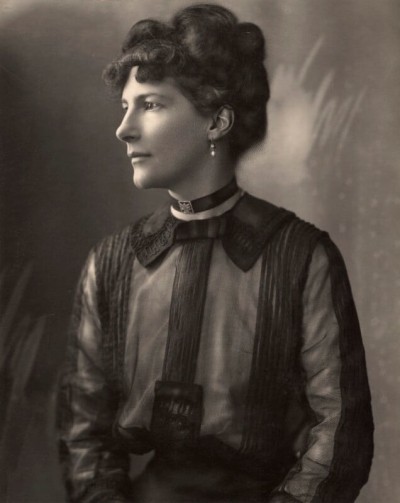
- Countess Haig, by H. Walter Barnett, © National Portrait Gallery, London
It was the visionary Countess Dorothy, wife of Field Marshal Douglas Haig, who saw an opportunity in 1926 to create the factory north of the Border, after the Royal British Legion founded the first of its kind in Richmond, on the banks of the Thames, in 1922.
And Scottish Veterans Residences – a charity established in 1910 as a sanctuary for homeless Veterans - is proud to have played a part in this origin story.
Following a visit to Whitefoord House in Edinburgh’s Royal Mile, Lady Haig chose the charity’s site as the ideal location to launch her factory, and produce poppies for the nation to mark Armistice Day each year. On 8th March 1926, Lady Haig together with two veteran workers, a pair of scissors and a piece of paper made the very first poppies in what was to become The Lady Haig Poppy Factory.
The original factory – situated in what is now the Maclagan Room at Whitefoord House – remained a bustling hive of activity until the early 1930s. Growing supply and demand first necessitated a short move to larger premises in nearby Panmure Close, then in 1965 to its present home at Warriston Road, Canonmills, where it is now operated by Poppyscotland (The Earl Haig Fund Scotland).
A look through the archives captures the factory’s inception. The SVR annual report of 1926-27 states: “In February 1926 the idea of starting a factory for the purpose of making poppies for sale on Poppy Day throughout Scotland was suggested by Lady Haig.
“The question of finding suitable, economical premises for the purpose of starting this new venture was one of some difficulty and Colonel William Robertson, VC, who was consulted, took Lady Haig down to the Scottish Naval and Military Veterans’ Residence, Whitefoord House, and suggested that it might be possible to get suitable accommodation to start the factory there. So delighted was Lady Haig with the premises proposed, that her committee proceeded to turn the old Wood Chopping Factory into a Poppy Factory without delay.
“As in the instance of the residence itself, the Poppy Factory was begun in a small way, and it was not long before it was seen that larger premises were required for the expansion and development of the work.”
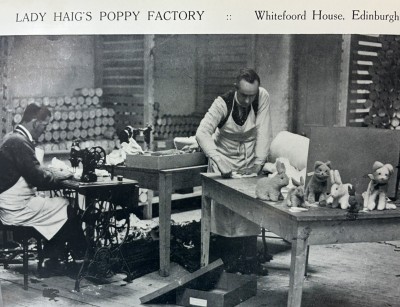
An initial workforce of 30 disabled former soldiers, representing 17 units of the Army, were employed in the factory and within the first year the factory trebled in size. In Year 1, they produced 488 wreaths, 157 poppy sprays, 6200 large silk poppies, 379,800 crepe paper poppies, 180,250 lawn poppies, 1,224,150 paper poppies and 7810 wreath poppies. Within two years, the factory was producing upwards of 3 million poppies and 1,500 wreaths.
One of the unsung heroes of the early operation and expansion was Colonel Archibald Cambell Holms Maclean, CBE, who managed the venture and was the driving force behind its early success. Either side of his involvement with the poppy factory, he served in the First and Second World Wars.
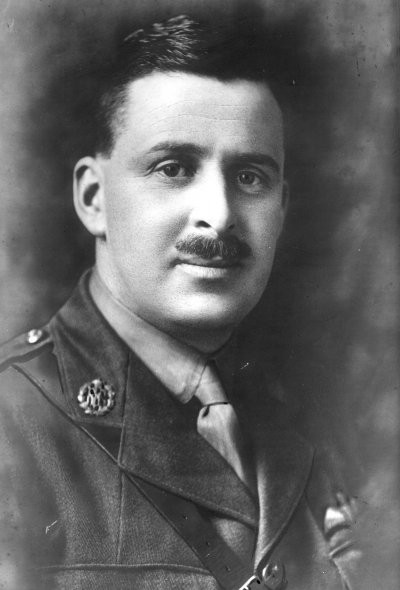
- Colonel Archibald Campbell Holms Maclean
Col Maclean, born in 1883, was an officer in the Royal Scots, Royal Flying Corps and Royal Air Force, and served between 1903 and 1925. Following the outbreak of the Second World War, he was recalled to service for three further years and granted a commission in the Administrative and Special Duties Branch of the Reserve of Air Force Officers as a pilot officer. He died aged 86 in 1970 and was laid to rest in Glasgow.
The Scottish Poppy was originally designed by Lady Haig in 1926 with four-lobed crimped petals rather than the two petals and a green leaf for English poppies. In a 1927 newspaper interview, Col Maclean explained the intricate technical process of producing the early poppies and wreaths.
He said: “The poppies are formed out of lawn, sateen, silk, and paper, and all the materials are made in Britain. There are quite a number of different processes to be gone through in the production of a single poppy. has to be stamped out by a cutter, dyed, put through a machine to give it the crinkles, and then made up into the flower. The centre has to be cut and stamped, coconut fibre put in, and the tips dipped in boiling wax to make the seed. The process, allowing for the drying after dyeing, takes 48 hours.”
As the need for employment grew, the poppy factory expanded its range of goods, producing good quality, hand-crafted items including furniture, wooden and soft toys, leather goods and flower bowls fashioned from old gramophone records. Two shops were opened in the Canongate and Lawnmarket as showrooms for the display and sale of products, and in 1930 further premises were acquired in Calton Road – named Maryat House in honour of the lady who had donated funds for this purpose.
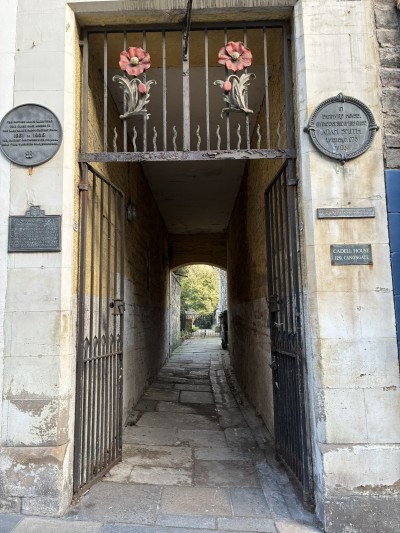
- Plaque marking the entrance to the Panmure Close factory
During the 1930s, the factory enjoyed great prosperity, especially when it moved to its new home. The workforce grew to 117 with a waiting list of 338 hoping to join them. That momentum continued into the Second World War, and in 1955 the standard lapel poppy was introduced, almost identical to the one we use today.
Lady Haig’s Poppy Factory continues to employ disabled veterans to make the poppies every year for the Scottish Poppy Appeal and they also make thousands of poppy wreaths which are sold commercially across the UK and beyond.
Updated systems mean the factory can meet current and future demand, producing three million poppies, 40,000 wreaths and thousands of other Remembrance items annually. Incredibly, the reliable 1926 machine used in Whitefoord House to cut the silk petals for wreaths is still going strong!
For more information, visit:
https://www.poppyscotland.org.uk/lady-haigs-poppy-factory
 RSS
RSS